

Payment Gateway Market to Reach USD 82.01 Billion by 2035 Amid Digital Payment Boom
payment gateway market
Payment Gateway Market Size, Share and Research Report By Type (Hosted, Non-hosted), By Enterprise Size (Large Enterprises, Small & Medium Enterprises)
Payment Gateway Market – The rapid shift toward digital payments and e-commerce is accelerating the growth of the global payment gateway market.”
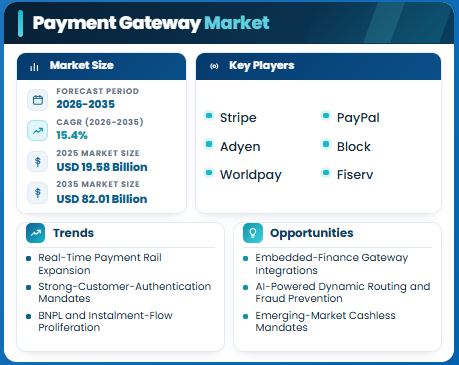
TOKYO, TOKYO, JAPAN, July 14, 2026 /EINPresswire.com/ -- The Global payment gateway market was valued at USD 19.58 billion in 2025 and is projected to grow from USD 22.60 billion in 2026 to USD 82.01 billion by 2035, registering a CAGR of 15.4% during the forecast period. — Market Research Future (MRFR)
Two major catalysts are accelerating this extraordinary trajectory: the global proliferation of real-time payment rails India’s Unified Payments Interface crossed 14 billion monthly transactions by early 2025 and Brazil’s Pix system processed over BRL 17 trillion in 2024, with each merchant-acceptance flow generating an API call through a payment gateway and the expanding wave of strong-customer-authentication mandates rolling across the EU, Southeast Asia, and the Middle East, which are compelling merchants to migrate from legacy batch-processing architectures to hosted gateway platforms capable of handling tokenized 3-D Secure 2.x authentication flows without in-house cryptography teams.
Governments and central banks across at least 130 countries are actively incentivizing cashless commerce and piloting CBDC programs, and every incremental percentage point of card or wallet penetration translates directly into sustained gateway transaction volume growth through 2035.
Legacy batch-processing payment architectures are giving way to API-first, microservices-based gateway stacks capable of handling tokenized card-on-file flows, buy-now-pay-later decisioning, and multi-acquirer routing within a single call. Global venture capital investment in payment infrastructure exceeded USD 18 billion in 2024, with significant capital flowing into orchestration layers that add intelligent routing logic atop traditional gateways, improving authorization rates by 2–4 percentage points and reducing false-decline losses that cost global merchants an estimated USD 443 billion annually.
The European Commission’s publication of the final PSD3 text and Payment Services Regulation in March 2025 establishing new gateway interoperability requirements and API standardization mandates and Block’s integration of Afterpay’s BNPL product directly into the Square Online gateway in early 2022, enabling single-API instalment checkout together illustrate the regulatory and commercial forces that are simultaneously expanding the gateway market’s addressable opportunity and raising the engineering bar for competitive participation.
Get Full PDF Sample Copy of Report: (Including Full TOC, List of Tables & Figures, Chart) @
https://www.marketresearchfuture.com/sample_request/18853
➤ How Significant Is the Payment Gateway Market’s Growth?
The payment gateway market has demonstrated extraordinary expansion, on course to more than quadruple from USD 19.58 billion in 2025 to USD 82.01 billion by 2035 a growth trajectory matched by few enterprise technology markets of comparable current scale. Hosted gateways account for approximately 52% of 2025 revenue, reflecting merchant preference for rapid integration, PCI compliance offloading through the lightest SAQ A self-assessment pathway, and the ability to go live with compliant checkout flows in hours rather than weeks using platforms like Stripe Checkout and PayPal’s hosted payment pages. Self-hosted deployments hold the remaining 48% share and are forecast to expand at a 15.2% CAGR through 2035 as enterprise merchants demand granular control over tokenization vaults, custom checkout user experience design, and proprietary fraud-scoring model integration within their own infrastructure.
Small and medium enterprises drove approximately 60% of the 2025 payment gateway market transaction volume by merchant count, enabled by low-code plug-in integrations with Shopify, WooCommerce, and equivalent platforms, alongside flat subscription pricing models that eliminate per-transaction fee complexity for early-stage operators. Large enterprises, while fewer in number, generate significantly higher per-merchant revenue and are investing in multi-acquirer orchestration platforms that dynamically route each transaction to the acquirer most likely to approve it at the lowest cost.
The retail and e-commerce vertical represented approximately 29% of 2025 demand, while travel and hospitality is projected to record the fastest segment CAGR of 15.8% through 2035, driven by airline and hotel adoption of multi-currency settlement gateways that reduce FX conversion friction and improve authorization rates across regional acquirers. BNPL proliferation has amplified gateway call volumes by a factor of three to five per order compared with a standard card transaction, as each instalment checkout triggers an initial authorization, a soft-credit decisioning webhook, and subsequent capture calls.
➤ What Does the Future Hold for the Payment Gateway Market?
AI-native gateway architecture and embedded-finance integration stand at the forefront of the payment gateway market’s next growth phase. By 2028, leading gateway providers are expected to transition from bolting AI fraud models onto legacy stacks toward deploying AI-native architectures where machine learning governs routing decisions, authorization-retry logic, and fee optimization in real time with 60% of payment infrastructure decisions projected to be AI-mediated by 2030.
Checkout.com and Adyen have already deployed adaptive-routing engines that merchants report deliver 2–4 percentage point authorization rate improvements, and this technology is now expanding downmarket to mid-market gateway operators as model training costs decline and pretrained fraud-detection models become available via API. Adyen’s Data Connect for Marketing and Stripe’s Revenue Recognition suite illustrate how leading gateways are supplementing per-transaction revenue with premium analytics and treasury-management module subscriptions that are insulated from the downward pressure on base processing fees.
The rise of marketplace and platform business models is bifurcating the gateway market into two structurally distinct tiers. Simple hosted checkout gateways serve the long tail of SME merchants, while full-stack orchestration platforms capable of split-settlement, multi-party escrow management, and compliance across multiple regulatory jurisdictions in a single API call serve the Shopify merchant ecosystems, Uber multi-sided platforms, and global travel aggregators that collectively generate the highest per-merchant gateway revenue, estimated at three to five times the average revenue of simple checkout-only relationships.
Embedded-finance gateway integrations represent the market’s most expansive long-term opportunity: payments acceptance is being woven into SaaS billing tools, healthcare scheduling apps, property management platforms, and gig-economy workforce platforms a structural shift that anticipates USD 230 billion in global embedded finance revenue by 2030, with gateway API providers best positioned to capture the integration fee layer.
CBDC retail settlement integration represents the most disruptive long-term force shaping the payment gateway market’s future. With 36 countries in active CBDC pilot or production phases as of 2025 including the EU’s digital euro, China’s e-CNY, and Saudi Arabia’s Aber program retail CBDCs will require gateway-layer integration to bridge central-bank digital wallets with existing merchant-acceptance infrastructure.
CBDC transactions bypass card-network interchange fees entirely, and early pilots suggest per-transaction costs 40–60% below card equivalents, which will progressively shift gateway pricing models from interchange-plus toward flat per-transaction or subscription structures. The UAE’s Digital Dirham CBDC pilot launched in late 2024 and Saudi Arabia’s mandate requiring all licensed merchants to accept at least one digital payment method by 2026 are the most proximate examples of the government-driven digitization mandates that will sustain payment gateway market demand through 2035.
➤ Who Are the Key Players in the Payment Gateway Market?
The payment gateway market exhibits medium concentration, with an estimated top-five revenue share of 35–42% and no single player commanding more than 12% of global revenue. Three competitive tiers define the landscape: global full-stack processors, legacy acquirer-linked gateways, and region-specific challengers dominating local corridors. Key participants shaping the competitive dynamics include:
★ Stripe - the payment gateway market’s largest pure-play platform with an estimated 8–11% global revenue share, offering Stripe Payments, Billing, Connect, and Radar as a full-stack platform for internet businesses; introduced carbon-calculation APIs tied to payment flows and reduced standard processing fees for high-volume U.S. merchants by 30 basis points in 2024, reflecting strategic emphasis on value-added services over per-transaction revenue.
★PayPal (Braintree) - the consumer-wallet-linked gateway ecosystem leader with an estimated 7–10% global revenue share, delivering Braintree gateway, PayPal Checkout, and Venmo integration; Braintree’s developer-centric API approach enables enterprise merchants to build custom payment flows while leveraging PayPal’s 400 million-plus consumer wallet network for one-tap checkout authorization rate uplift.
★ Adyen - the unified commerce platform for global enterprise merchants with an estimated 5–8% revenue share, operating its own acquiring network across North America, Europe, and Asia-Pacific to eliminate third-party acquirer dependencies; the RevenueAccel intelligent-acceptance suite and Data Connect for Marketing analytics offering represent Adyen’s transition from pure-play gateway to data-intelligence platform.
★ Block (Square) - the SME-focused omnichannel gateway and payments suite with an estimated 4–7% revenue share, integrating Afterpay’s BNPL directly into Square Online in January 2022 to enable single-API instalment checkout; Cash App’s consumer network and Square’s POS hardware ecosystem give Block unique omnichannel breadth across in-store and digital channels.
★ Worldpay (FIS) - the legacy acquirer-linked gateway with the broadest global geographic coverage at an estimated 4–6% revenue share, offering FraudSight machine-learning fraud detection alongside its gateway and acquiring infrastructure; serving large multinational merchants who require a single gateway relationship covering card-not-present acceptance across more than 146 currencies.
★ Fiserv (Clover) - the bank-channel distribution leader with an estimated 3–5% revenue share, whose Carat enterprise payment platform and Clover POS gateway ecosystem are distributed through thousands of financial institution partnerships, giving Fiserv unmatched SME reach in the North American market through trusted banking relationships rather than direct sales channels.
★ Checkout.com - the enterprise-grade modular gateway with an estimated 2–4% revenue share, whose Intelligent Acceptance platform and Flow orchestration layer are deployed by global enterprise and marketplace merchants seeking granular routing control, real-time authorization-rate analytics, and the ability to dynamically switch acquirers based on live approval-rate and cost signals.
★ Razorpay - the India-dominant gateway and fintech platform with an estimated 2–4% global revenue share growing rapidly through UPI merchant acceptance expansion; its RazorpayX banking-infrastructure product and Payment Pages no-code checkout tool have made it the default gateway for Indian startups and SMEs, with active APAC expansion targeting Southeast Asian UPI-equivalent real-time rail integrations.
★ Competition in the market is intensifying as gateway orchestration platforms give merchants real-time visibility into routing costs, accelerating downward pressure on take-rates and compelling providers to differentiate on value-added services fraud analytics dashboards, treasury-management modules, revenue-recognition automation, and ESG carbon-calculation APIs rather than per-transaction connectivity alone. Regional challengers including Paystack in Africa, Grab Financial in Southeast Asia, and Mercado Pago in Latin America are commanding dominant local market positions that global platforms find difficult to displace without deep regulatory and language localization investment.
➤ What Are the Emerging Trends in the Payment Gateway Market?
Several transformational trends are redefining how the payment gateway market evolves through 2035:
Real-Time Payment Rail Expansion & Gateway Integration: India’s UPI at 14 billion monthly transactions, Brazil’s Pix at BRL 17 trillion in 2024 annual volume, Mexico’s DiMo interoperable-wallet system, and the U.S. FedNow service targeting 2,000 financial institution participants by 2027 are collectively building a global network of instant-settlement rails whose merchant-acceptance flows each generate incremental gateway API calls making real-time rail adoption the single strongest structural CAGR driver at an estimated +2.8 percentage points.
AI-Native Routing, Fraud Prevention & Dynamic Pricing: Machine-learning models optimizing real-time acquirer selection are delivering 2–4 percentage point authorization rate improvements and reducing the USD 443 billion in annual false-decline losses that erode merchant revenue globally. Gateway providers embedding AI fraud scoring, adaptive-retry logic, and interchange optimization are transitioning from pure-connectivity commodities to intelligent payment-intelligence layers commanding premium SaaS pricing and multi-year merchant contracts.
BNPL & Instalment-Flow Integration: Global BNPL transaction volume surpassed USD 400 billion in 2024, and each BNPL checkout multiplies gateway API call volumes by three to five times compared to a standard card transaction. Block’s Afterpay integration into Square Online and Stripe’s Klarna and Affirm partnership APIs are making BNPL gateway integration a standard checkout feature rather than a premium add-on, driving both volume uplift and average order value improvements for merchant partners.
Strong-Customer-Authentication & Open-Banking Compliance: PSD3 and the EU Payment Services Regulation’s API interoperability mandates, Singapore MAS’s phased SCA framework, and the UK’s open-banking ecosystem already serving over 11 million active users with account-to-account payments growing 64% year-on-year in 2024 are creating non-discretionary compliance investment requirements that systematically redirect merchant payment infrastructure spending toward gateway platforms with certified SCA and open-banking integration capabilities.
CBDC & Programmable-Money Gateway Integration: With 36 countries in active CBDC pilot or production phases and the EU digital euro, UAE Digital Dirham, and e-CNY each approaching merchant-acceptance production rollout between 2027 and 2030, gateways that build CBDC bridge infrastructure early will capture integration revenue and establish protocol-layer switching costs that are extremely durable competitive advantages in the jurisdictions where programmable-money rails go live.
Omnichannel POS-to-Online Unification & Embedded Finance: Retailers and marketplace operators increasingly demand a single gateway API that unifies in-store terminal transactions, online checkout, mobile in-app payments, and embedded third-party platform acceptance under one token vault, one analytics dashboard, and one settlement entity creating upsell opportunities for gateway providers as merchants consolidate from multi-vendor point solutions and as SaaS platforms embed payment acceptance as a native subscription-tier feature worth an estimated USD 230 billion in embedded-finance revenue globally by 2030.
Get access to the full description of the report @
https://www.marketresearchfuture.com/reports/payment-gateway-market-18853
➤ How Is the Payment Gateway Market Segmented?
The payment gateway market report provides a comprehensive segmentation framework:
By Type: Hosted Gateway, Self-Hosted (Non-Hosted) Gateway, API-Integrated & Headless Gateway, Local Bank Integration Gateway
By Enterprise Size: Large Enterprises, Small and Medium Enterprises (SMEs)
By Channel: Online & Web-Based Checkout, Mobile In-App Payments, In-Store POS
Omnichannel, Voice & Conversational Commerce
By End-Use Industry: Retail & E-Commerce, BFSI, Travel & Hospitality, Media & Entertainment, Healthcare, Education, Government & Utilities, Others
By Payment Method: Credit & Debit Cards, Digital Wallets & Mobile Payments, Bank Transfers & ACH, Buy Now Pay Later (BNPL), Real-Time Payments (UPI, Pix, FedNow), Cryptocurrency & Stablecoins, CBDC
➤ What Are the Regional Insights from the Payment Gateway Market?
Asia-Pacific commands the largest regional share at approximately 36.5% of 2025 payment gateway market revenue, powered by the super-app ecosystems and real-time payment rails that make the region’s digital payment infrastructure the most advanced in the world by transaction volume. China alone accounts for USD 2.84 billion of regional gateway revenue in 2025, driven by Alipay and WeChat Pay ecosystems that are extending cross-border acceptance to outbound tourists across Southeast Asia and Europe through Alipay+ and WeChat Pay Global
North America holds approximately 28% of global payment gateway market revenue in 2025, driven by the world’s highest card penetration rates, a rapidly maturing BNPL ecosystem, and intense competition among established processors and fast-scaling fintech challengers.
Europe holds approximately 22% of global payment gateway market revenue in 2025, defined by the most ambitious regulatory framework for gateway interoperability in the world. PSD3 and the EU Payment Services Regulation finalized in March 2025 mandate API-level interoperability between gateway providers and account-servicing payment service providers, creating significant compliance investment requirements and opening new gateway integration opportunities around account-to-account payment initiation.
➤➤➤ Industry Analysis Reports by Market Research Future:
Risc V Tech Market-
https://www.marketresearchfuture.com/reports/risc-v-tech-market-38126
Consumer Durable Loans Market-
https://www.marketresearchfuture.com/reports/consumer-durable-loans-market-40608
Gaas Wafer Market
https://www.marketresearchfuture.com/reports/gaas-wafer-market-6473
Document Management System Market
https://www.marketresearchfuture.com/reports/document-management-system-market-6498
Digital Badges Market
https://www.marketresearchfuture.com/reports/digital-badges-market-6706
Multi-Vendor Support Services Market
https://www.marketresearchfuture.com/reports/multi-vendor-support-services-market-7200
Multi-Chip Module Market
https://www.marketresearchfuture.com/reports/multi-chip-module-market-7380
Semiconductor Memory Ip Market
https://www.marketresearchfuture.com/reports/semiconductor-memory-ip-market-7453
Electronic Weighing Scale Market
https://www.marketresearchfuture.com/reports/electronic-weighing-scale-market-7604
Serial Nor Flash Market
https://www.marketresearchfuture.com/reports/serial-nor-flash-market-7668
Sagar Kadam
Market Research Future
+ +1 628-258-0071
email us here
Legal Disclaimer:
EIN Presswire provides this news content "as is" without warranty of any kind. We do not accept any responsibility or liability for the accuracy, content, images, videos, licenses, completeness, legality, or reliability of the information contained in this article. If you have any complaints or copyright issues related to this article, kindly contact the author above.
