

Precipitated Silica Market to Reach USD 7.0 Billion by 2036, Asia Pacific Leads with Evonik & Tokuyama Driving Growth
Precipitated Silica Market
Precipitated silica demand rises with tire efficiency, oral care, and industrial applications, driven by performance, sustainability, and global manufacturing.
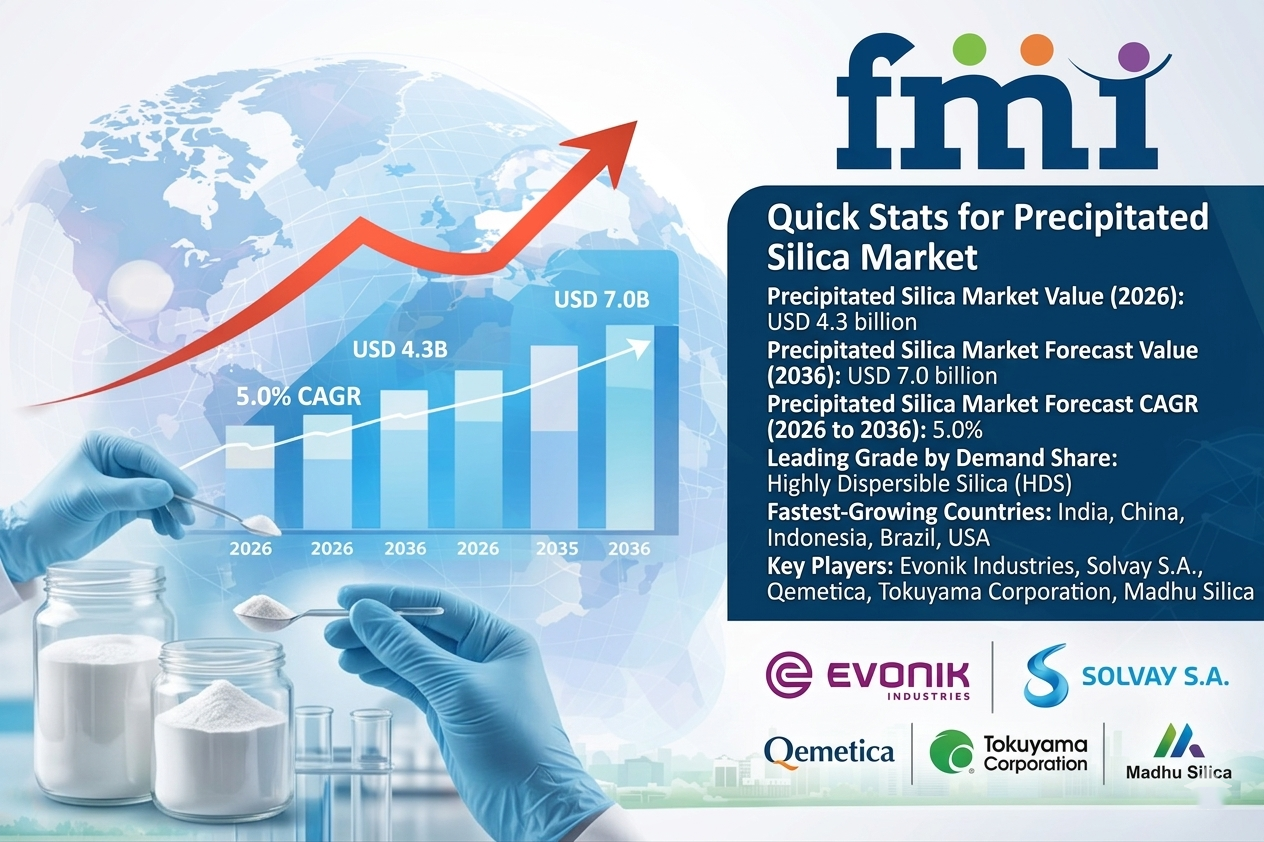
NEWARK, DE, UNITED STATES, April 2, 2026 /EINPresswire.com/ -- The global precipitated silica market is valued at USD 4.3 billion in 2026 and is projected to reach USD 7.0 billion by 2036, expanding at a CAGR of 5.0% during the forecast period. Growth is driven by increasing demand for performance-enhancing materials in tire manufacturing, oral care formulations, and industrial applications where durability, efficiency, and functional consistency are critical.
As industries shift toward advanced materials that deliver measurable performance benefits, precipitated silica is evolving from a commodity filler into a strategic performance ingredient. Its role in improving rolling resistance, wet grip, viscosity control, and product stability positions it at the core of modern manufacturing and formulation science.
Precipitated Silica Market Snapshot (2026–2036)
• Market size in 2026: USD 4.3 billion
• Market size in 2036: USD 7.0 billion
• CAGR (2026–2036): ~5.0%
• Leading grade: Highly Dispersible Silica (HDS)
• Top application: Tires & rubber
• Dominant function: Reinforcement and rheology control
• Fastest-growing countries: India, China, Indonesia
• Key companies: Evonik Industries, Solvay S.A., Qemetica, Tokuyama Corporation, Madhu Silica
Market Momentum
The precipitated silica market begins at USD 4.3 billion in 2026, supported by strong demand from tire manufacturing and industrial rubber applications. Between 2027 and 2030, advancements in highly dispersible silica (HDS) and improved processing technologies accelerate adoption across automotive and industrial sectors.
By 2032, increasing use in oral care, coatings, and specialty chemicals, along with innovations in particle engineering and surface chemistry, strengthens demand globally. Expansion of manufacturing in Asia-Pacific further supports market scalability.
By 2036, the market reaches USD 7.0 billion, driven by widespread adoption in performance-driven applications such as energy-efficient tires, personal care products, and industrial formulations requiring precision-engineered materials.
Request For Sample Report | Customize Report | Purchase Full Report
https://www.futuremarketinsights.com/reports/sample/rep-gb-11073
Why the Market is Growing
The precipitated silica market is expanding as industries increasingly prioritize materials that offer functional performance advantages over traditional fillers. In tire manufacturing, precipitated silica enhances rolling resistance, fuel efficiency, and traction—aligning with global regulatory pressures for reduced emissions and improved vehicle efficiency.
Beyond mobility, its use as a controlled abrasive, thickener, and absorbent supports steady demand in oral care and personal care products. Toothpaste formulations rely on silica for polishing and cleaning performance, while cosmetics use it for oil absorption and texture enhancement.
Additionally, advancements in silica production technologies enable precise control over particle size, surface area, and morphology, allowing manufacturers to tailor products for specific applications. This shift toward customization reinforces demand for high-quality, performance-driven grades over commodity alternatives.
Segment Spotlight
1. Grade: Highly Dispersible Silica Leads Market
Highly dispersible silica (HDS) accounts for approximately 46.0% of the market, driven by its superior dispersion in rubber matrices and its role in energy-efficient tire formulations.
2. Application: Tires & Rubber Dominate
Tires and rubber applications hold around 57.0% share, reflecting precipitated silica’s critical role in enhancing durability, wear resistance, and fuel efficiency in automotive components.
3. Specialty Segment: Oral Care Adds Value
Oral care applications represent a high-value segment, where silica is used as a controlled abrasive and thickening agent, meeting stringent regulatory and performance standards.
Drivers, Opportunities, Trends, Challenges
• Drivers: Growing automotive production, demand for fuel-efficient tires, expansion of consumer goods manufacturing
• Opportunities: Eco-friendly silica production, advanced material engineering, specialty application development
• Trends: Shift toward HDS grades, increased use in personal care, precision formulation requirements
• Challenges: High production costs, raw material price volatility, regulatory compliance for particulate materials
Country Growth Outlook (2026–2036)
India leads the market with a CAGR of 7.0%, supported by strong growth in tire manufacturing and industrial rubber consumption. China follows at 6.3%, driven by large-scale automotive and manufacturing industries. Indonesia records 6.0%, benefiting from expanding rubber processing capacity.
Brazil shows moderate growth at 4.1%, reflecting stable demand in automotive and industrial sectors, while the USA grows at 3.1%, characterized by a mature market with incremental innovation-driven demand.
Competitive Landscape
The precipitated silica market features a mix of global manufacturers competing on product performance, consistency, and innovation. Companies are investing in advanced precipitation technologies, improved dispersion characteristics, and sustainable production methods to strengthen their market position.
Competition is increasingly centered on application-specific customization, regulatory compliance, and supply chain reliability. Leading players are expanding production capacities and enhancing technical support services to meet evolving customer requirements across industries.
Key players include Evonik Industries, Solvay S.A., Qemetica (PQ Silicas), Tokuyama Corporation, and Madhu Silica, each focusing on innovation and global expansion strategies.
Frequently Asked Questions (FAQ)
What is the global precipitated silica market size?
The market is valued at approximately USD 4.3 billion in 2026 and is projected to reach USD 7.0 billion by 2036.
At what rate is the market expected to grow?
The market is expected to expand at a CAGR of around 5.0% from 2026 to 2036.
What is precipitated silica used for?
It is used as a reinforcing filler, thickener, abrasive, and absorbent in applications such as tires, oral care, coatings, and industrial formulations.
Why is precipitated silica gaining importance?
Its ability to enhance performance, durability, and efficiency across multiple applications makes it a critical material in modern manufacturing.
Explore More Related Studies (Chemical & Materials)
Bioplastics Market
https://www.futuremarketinsights.com/reports/global-bio-plastics-market
Ultrapure Water Market
https://www.futuremarketinsights.com/reports/ultrapure-water-market
Blue Carbon Market
https://www.futuremarketinsights.com/reports/blue-carbon-market
About Future Market Insights (FMI)
Future Market Insights, Inc. (FMI) is an ESOMAR-certified, ISO 9001:2015 market research and consulting organization, trusted by Fortune 500 companies and global enterprises. With a strong presence across the U.S., UK, India, and the Middle East, FMI delivers actionable insights across 30+ industries and over 1,200 markets worldwide.
Why Choose FMI:
https://www.futuremarketinsights.com/why-fmi
Sudip Saha
Future Market Insights Inc.
+1 347-918-3531
rahul.singh@futuremarketinsights.com
Legal Disclaimer:
EIN Presswire provides this news content "as is" without warranty of any kind. We do not accept any responsibility or liability for the accuracy, content, images, videos, licenses, completeness, legality, or reliability of the information contained in this article. If you have any complaints or copyright issues related to this article, kindly contact the author above.
